
Getting started
Becoming self-employed in Mauritius in 2026: BRN, VAT, CSG and your first invoice
· 13 min read
Share:



Your first client said yes on WhatsApp. They want the job done by Friday and, before anything else, they ask the question that decides whether you look like a professional or an amateur: "Can you send me an invoice?"
That's when most new freelancers in Mauritius discover they don't have a BRN, don't know if they owe VAT and have never heard of CSG. The good news: going self-employed in Mauritius is one of the simplest administrative paths in the region. One registration with the CBRD, one online form with the MRA and you can invoice legally. The bad news: the few traps that do exist cost a lot. A fine of up to Rs 100,000 for working without a BRN. Up to Rs 50,000 for registering late for VAT. Compulsory VAT registration from your very first rupee if you are a consultant or an engineer.
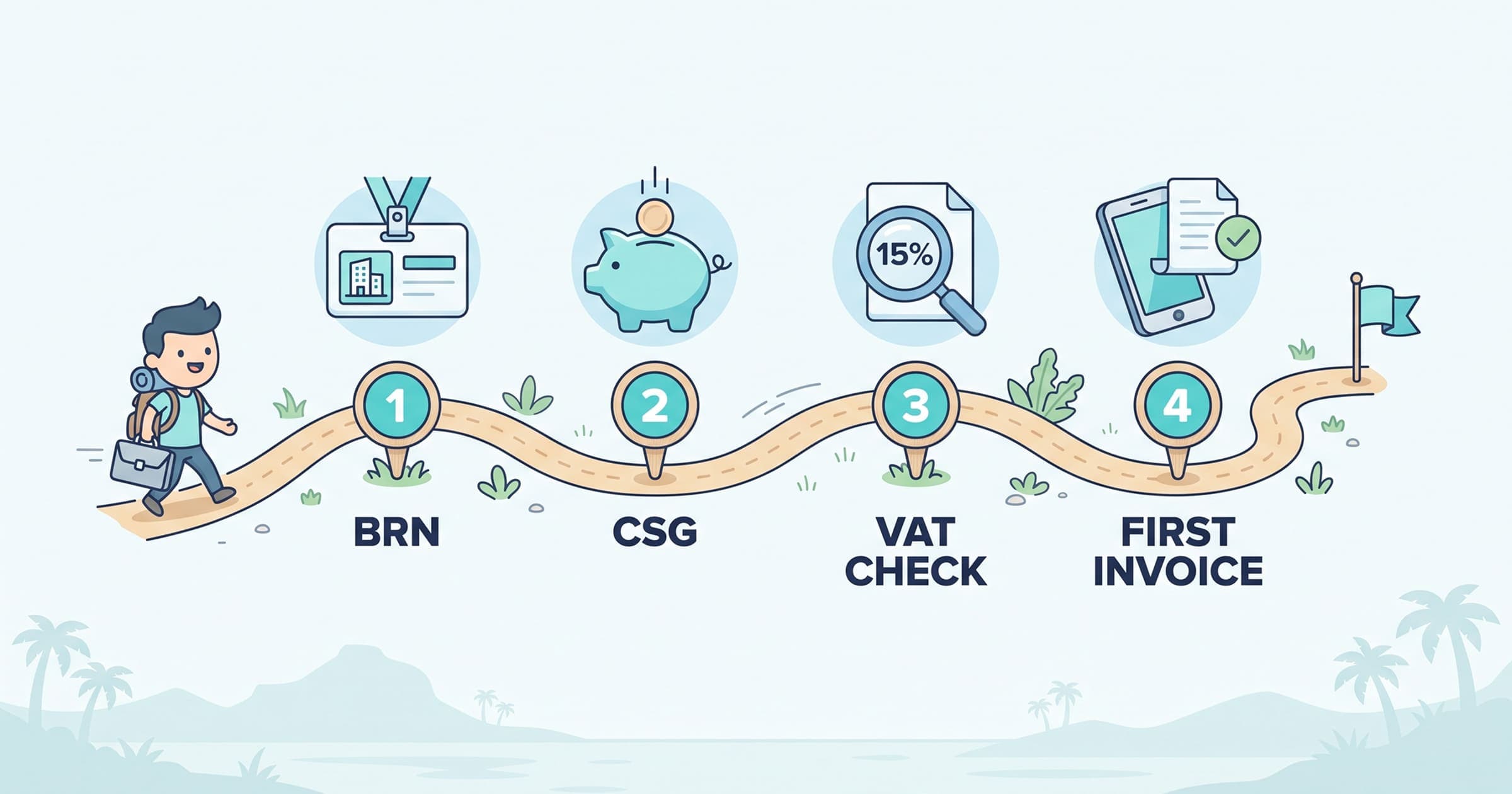
Here is the full roadmap, in the order you'll actually need it, with the 2026 figures and the legal texts behind them.
Step 1: get your BRN before you start
The Business Registration Number is the backbone of everything else. Without it, no legal invoice, no MRA account, no CSG.
Who needs one. The Business Registration Act 2002 defines "business" as any trade, profession, vocation or occupation carried on for gain or profit. Salaried employment is excluded. Everything else is in: web developer, graphic designer, photographer, translator, tutor, consultant, coach, electrician, make-up artist. Full time or as a side hustle after office hours, it makes no difference.
Working from home doesn't exempt you either. The only home-related exemption in the First Schedule concerns a craftsman working from his own home without business premises. A freelancer with a laptop on the dining table is not a craftsman in that sense.
When. Section 6(4) requires you to apply at least 2 days before you start the business. Section 6(6) sets the penalty for operating without registration: a fine of up to Rs 100,000. If you've already done a few paid jobs without a BRN, regularise now rather than waiting for a client's accountant to ask for it.
How. The CBRD page for individuals describes three steps:
- choose your activity in the CBRD trade code list (each code carries a trade fee, more on that below);
- obtain prior approval if your activity is regulated (a minority of trades);
- submit Form BRF1 online through CBRIS (after creating an MNS account) or at the counter at One Cathedral Square Building, Jules Koenig Street, Port Louis.
You need your NIC (or a passport if you are not a citizen), your full name, the nature of the business, your place of business and your start date. The CBRD then allocates your BRN and issues a Business Registration Card, electronic since 2016. You can hold only one BRN, whatever the number of activities: section 6(5) says one application covers everything.
Three details worth knowing:
- The card doesn't expire. The old three-year renewal rule was repealed in 2009. Some websites still claim otherwise.
- You must display it at your place of business, but since the Economic and Financial Measures (Miscellaneous Provisions) Act 2026 it can be "in any format": a PDF on your website or a QR code works.
- Changes must be reported within 14 days (new address, new activity) and cessation within 15 days. Each breach carries a fine of up to Rs 50,000.
Step 2: the trade fee, often zero for a new freelancer
The trade fee is a local tax collected by the CBRD on behalf of local authorities since January 2020. Its amount depends entirely on the trade code you chose. A few examples from the official schedule:
| Activity (individual) | Annual trade fee |
|---|---|
| Computer / ICT related activities | Rs 2,000 |
| Photographer | Rs 2,000 |
| Graphic design | Rs 7,000 |
| Business and/or management consultancy or professional service | Rs 7,000 |
Two exemptions change everything (CBRD notice):
- trades whose fee is Rs 5,000 or less are exempt, outside regulated activities (alcohol, gambling);
- any business registered on or after 5 August 2021 is exempt for its first two financial years.
In practice, a freelance developer pays no trade fee at all and a freelance consultant pays nothing for two years, then Rs 7,000 a year (payable in two instalments). Choose your trade code carefully: it must reflect what you really do rather than what costs least and it is the code your clients will see on your card.
As for permits: no Building and Land Use Permit is needed to run ICT, consultancy, photography or home-based tailoring activities from your home, as long as you don't build anything and cause no nuisance or parking problems (GN 250 of 2015). Unless your activity is regulated, you won't need a licence from the National e-Licensing System either.
Step 3: the MRA registers you automatically, but not for CSG
The MRA's Starting Business Guide (January 2026) is explicit: once the CBRD has issued your BRN, "you will automatically be registered as a taxpayer with the MRA". You receive a login and password for filing. There is no separate "self-employed registration" for income tax.
CSG is another matter. Every self-employed person must register for it themselves, online, with their NIC number, its date of issue and a mobile number that receives a one-time code (MRA CSG page). It's the step most beginners forget, because nobody prompts them.
Step 4: pay your CSG every month
The Contribution Sociale Généralisée replaced the old NPF contribution in 2020. For the self-employed, the rates have been unchanged since September 2021 and were left untouched by the 2025-2026 and 2026-2027 budgets:
| Monthly net income | Monthly CSG |
|---|---|
| Up to Rs 10,000 | Rs 150 flat |
| Rs 10,001 to Rs 50,000 | 1.5% of 90% of net income (minimum Rs 150) |
| Above Rs 50,000 | 3% of 90% of net income |
Two examples. You earn Rs 30,000 net in a month: 1.5% × Rs 27,000 = Rs 405. You earn Rs 60,000: 3% × Rs 54,000 = Rs 1,620. Net income means what you invoiced minus your business expenses, not your turnover.
Two options:
- monthly: return and payment by the end of the following month (two working days earlier for May and November). Each month you may compute on your actual net income or on one twelfth of the previous year's net income;
- annual: a single payment for the whole financial year (July to June), based on the previous year's net income, due by 15 October since the 2025-2026 Budget. The MRA's 2022 communiqué states the choice can't be changed once made. Logically, it suits people who already have a full year of activity behind them.
Payment is by direct debit only: the bank mandate form must reach the MRA at least 15 days before the first due date. Do it the same week as your registration.
Missing payments isn't trivial. The MRA can assess the CSG due plus a penalty of up to 25% and you lose eligibility for the benefits linked to the scheme. One detail for new arrivals: the CSG Income Allowance paid to low-income self-employed people is reserved to those registered as at 12 July 2024. Don't build your budget on it.
Finally, keep an eye on 2027. The 2026-2027 Budget annex announces the end of CSG collection in mid-2027, replaced by a defined-contribution National Pensions Fund from 1 July 2027. Self-employed people will take part, but their rates haven't been published yet. Until then, CSG remains due every month.
Step 5: income tax, simpler than you think
The scale. For income years 2025-2026 and 2026-2027, an individual pays:
- 0% on the first Rs 500,000 of chargeable income;
- 10% on the next Rs 500,000;
- 20% above Rs 1 million (and 35% above Rs 12 million from 2026-2027, under the Finance Act 2026).
A freelancer with Rs 700,000 of net profit over the year therefore pays 10% × Rs 200,000 = Rs 20,000 of income tax. Below Rs 500,000 of net income, nothing.
What you can deduct. All expenses incurred exclusively to earn your income: software subscriptions, internet, coworking, business travel. Equipment isn't depreciated but gives annual allowances: 50% a year for computer hardware and software, 100% for an item costing Rs 60,000 or less (MRA return notes). Keep every receipt: no receipt, no deduction.
The calendar.
- Annual return: 15 October, for e-filing and payment. For income year 2025-2026, that's Thursday 15 October 2026. Every self-employed person files, even with zero tax to pay. A standard return is required above Rs 500,000 of net income or Rs 2 million of gross business income, a simplified one otherwise.
- Quarterly instalments (CPS): only if your gross income for the previous year exceeded Rs 4 million. That won't be your concern in year one.
- Late filing costs up to Rs 5,000 for a small enterprise (Rs 2,000 per month), late payment 1% plus 0.25% interest per month.
One trap for those doing social media work: the Finance Act 2026 introduces a 5% tax deducted at source on payments made by companies for advertising and digital content services delivered through social media. Your client pays you 95% and pays the remaining 5% to the MRA on your behalf. It's not a loss: you offset it against your income tax in your annual return. But it must appear in your bookkeeping.
The 1% presumptive tax on gross income, often quoted on forums, is reserved to agriculture, manufacturing and the retail or wholesale of goods. Service freelancers are not eligible.
Step 6: VAT, the question that decides everything
This is where the most expensive mistakes happen, so let's be precise.
The general rule: Rs 3 million
Since 1 October 2025, VAT registration is compulsory once your taxable turnover exceeds or is likely to exceed Rs 3 million a year, down from Rs 6 million (MRA communiqué of 12 September 2025, section 15(1) and Sixth Schedule of the VAT Act). "Likely to exceed" matters: if you sign a Rs 3.5 million annual contract in month one, you are concerned right away, without waiting to have invoiced the amount.
Registering late costs Rs 5,000 per month of delay, capped at Rs 50,000 (section 15B), on top of the VAT you should have collected and now have to pay out of your own pocket.
The exception that catches freelancers: professions registered from day one
Section 15(2) and Part I of the Tenth Schedule list professions that must register whatever their turnover. Among them:
- accountant, auditor, adviser (including investment and tax adviser);
- architect, attorney, solicitor, barrister of more than 2 years' standing, notary;
- consultant, including legal, tax and management consultant;
- engineer, project manager, quantity surveyor, property valuer, land surveyor;
- advertising agent, estate agent, optician.
The word "including" makes the consultant category open-ended: on its wording, an IT, marketing or HR consultant is arguably caught. The same goes for "engineer", which isn't limited to civil engineers. The MRA has published no definition on these points. If your title or your trade code contains "consultant", "engineer" or "project manager", ask the MRA in writing before you issue your first invoice. Discovering two years later that you should have charged 15% on everything means paying that VAT yourself.
Employees aren't spared: section 15(2)(b) catches an employee who practises one of these professions alongside their job.
Foreign clients: zero-rated and a useful exemption
Many Mauritian freelancers work for clients in France, the UK or Australia. Item 6(a) of the Fifth Schedule zero-rates services supplied to a person belonging in another country, outside Mauritius when the services are performed and provided the services are not consumed in Mauritius.
Two consequences:
- these zero-rated supplies count toward the Rs 3 million threshold;
- but section 15(3) provides that a person whose turnover consists exclusively of zero-rated supplies is not bound to register. A freelancer who invoices only foreign clients can therefore stay outside VAT, even above Rs 3 million. As soon as one local client appears, everything counts.
Should you register voluntarily?
Section 16 allows it, provided you keep proper records and are up to date with the MRA. The advantage: you recover the VAT on your purchases (computer, software, coworking) and you look more established to large companies. The drawback: you must add 15% to all your local invoices, which hurts with private clients who can't recover it. You also file a return every quarter, nil or not (within 20 days of the end of the quarter or by the end of the following month if you file and pay online). For a beginner invoicing mostly individuals, it's rarely worth it. For a freelancer invoicing VAT-registered companies with significant purchases, it deserves a calculation.
Step 7: your first invoice, from day one
Back to your first client and their question. Even without VAT, you have invoicing obligations and they apply from your first job.
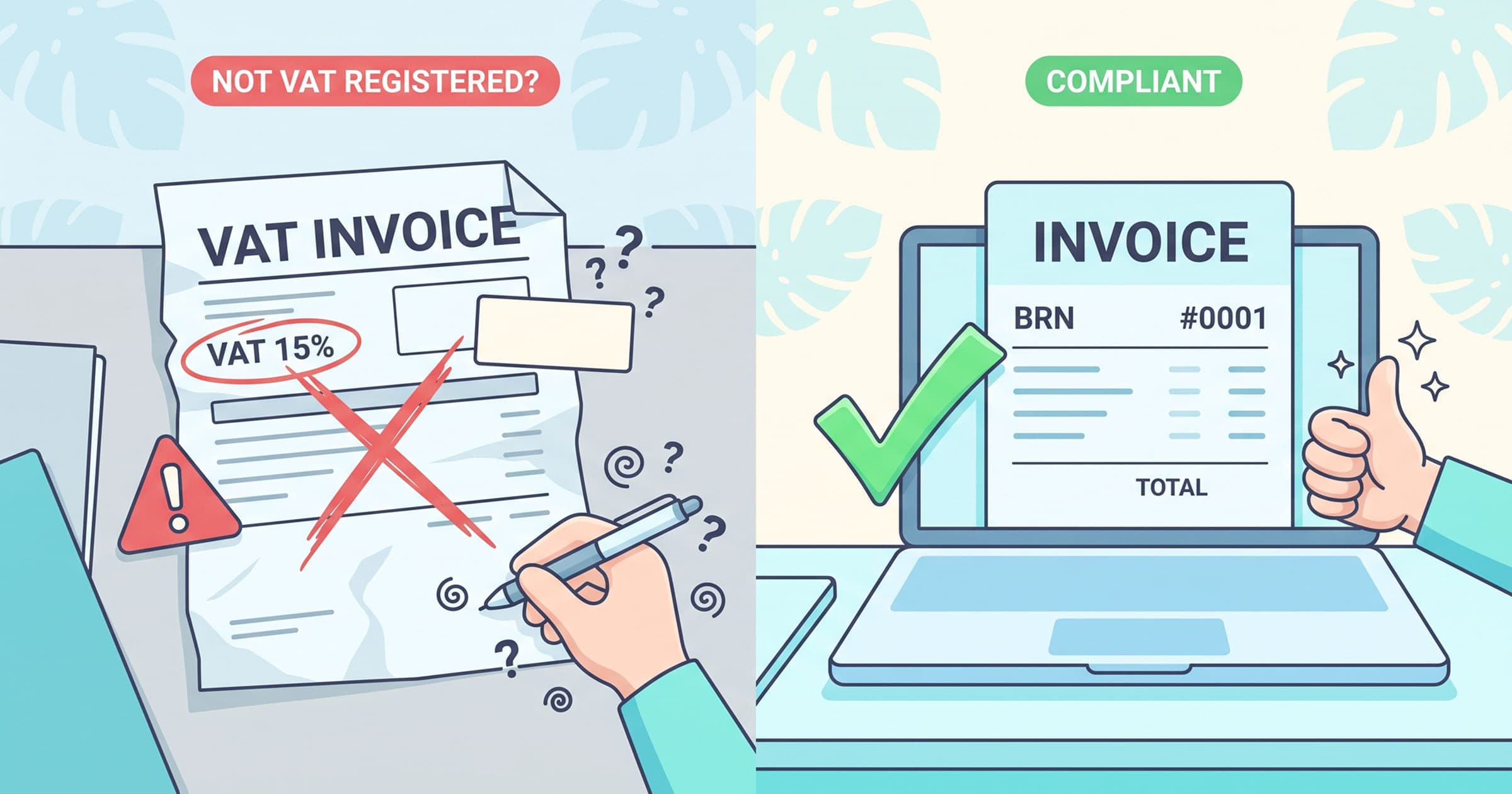
What the law requires of every business, VAT-registered or not. Section 19 of the VAT Act applies to "every person": you must issue a receipt or invoice for every supply, keep a copy and keep your records for at least 5 years (MRA record-keeping guide). Section 14(1) of the Business Registration Act adds that your BRN (plus your client's if they have one) must appear on every transaction document. Each breach carries a fine of up to Rs 100,000.
What you must not do if you aren't registered. Section 20(5) of the VAT Act forbids issuing a "VAT invoice" or any document showing an amount presented as VAT. No "VAT 15%" line, no "VAT INVOICE" title, no VAT number invented or borrowed. Presenting yourself as registered is an offence punishable by a fine of up to Rs 500,000 (section 59(b)). It's a classic mistake by people who copy a template downloaded from the internet without understanding it.
A serious invoice from a non-VAT-registered freelancer therefore contains:
- your name, address and BRN;
- your client's name, address and BRN if they are a business;
- a sequential invoice number, with no gaps or duplicates;
- the date of issue;
- a clear description of the service, quantities and unit prices;
- a single total, without a VAT line;
- your payment terms and bank details.
On the day you register for VAT, the list grows: the words "VAT INVOICE", your VAT number, the amount excluding VAT, the rate, the VAT amount and the exchange rate if you invoice in a foreign currency, as required by section 20(2). Our guide on how to create a compliant VAT invoice in Mauritius details each field. Note also that since 1 October 2026, VAT becomes due no later than three months after the service is performed, even if you haven't invoiced yet (Finance Act 2026): an invoice forgotten in a drawer no longer delays anything.
And MRA e-invoicing? Compulsory phases currently concern businesses above Rs 40 million of turnover (MRA e-invoicing page). A beginner freelancer is not in scope, but section 20A(2)(b) allows the Director-General to require it by written notice from anyone, registered for VAT or not. The details are in our article on MRA e-invoicing.
Why not start with a Word template?
Because the template knows none of the rules above. It doesn't know your last invoice number, so you'll skip one or reuse one. It doesn't stop you from leaving the "VAT 15%" line inherited from the original. It doesn't remind you of your client's BRN. And five years of archives scattered across a Downloads folder is exactly what the MRA asks you to produce in case of an audit. We've listed these pitfalls in our article on Excel and Word invoice templates in Mauritius.
Your checklist for the first week
| When | What | Where |
|---|---|---|
| 2 days before your first job | Apply for your BRN (Form BRF1) | CBRD, online via CBRIS or in Port Louis |
| On receipt of the BRN | Check your MRA login | MRA e-services |
| Same week | Register for CSG and send the direct debit mandate | MRA e-services |
| Before the first invoice | Check whether your profession is in the Tenth Schedule | VAT Act, MRA |
| Day one | Issue a numbered invoice with your BRN | Your invoicing tool |
| End of each month | CSG return and payment | MRA e-services |
| 15 October | Annual income tax return | MRA e-services |
| If turnover approaches Rs 3 million | Apply for VAT registration | MRA e-services |
FAQ
How much does it cost to register as self-employed in Mauritius?
Very little. The CBRD lists no registration fee for individuals on its page: the cost depends on the trade fee attached to your activity code. Activities whose trade fee is Rs 5,000 or less are exempt (computer and ICT activities for individuals are listed at Rs 2,000) and every business registered since 5 August 2021 is exempt for its first two financial years. Then count Rs 150 a month minimum of CSG.
Do I need a BRN if I freelance from home part time?
Yes. The Business Registration Act covers every profession, vocation or occupation carried on for profit, full or part time. The only home-based exemption concerns a craftsman working from his own home without business premises. Working without a BRN exposes you to a fine of up to Rs 100,000.
Is registration with the MRA separate from the BRN?
Not for income tax. According to the MRA's Starting Business Guide (January 2026), once the CBRD has issued your BRN you are automatically registered as a taxpayer and receive your login. CSG registration is a separate step, online, with your NIC number and a mobile phone.
Do I have to register for VAT as a freelancer?
Above Rs 3 million of taxable turnover, yes. Below that, it depends on your profession: accountants, advisers, architects, attorneys, consultants, engineers, project managers, estate agents and the other professions in the Tenth Schedule of the VAT Act must register whatever their turnover. A freelancer who invoices only foreign clients with zero-rated services is not bound to register, even above the threshold.
Can I write VAT on my invoices if I am not VAT-registered?
No. Section 20(5) of the VAT Act forbids issuing a VAT invoice or any document showing an amount presented as VAT unless you are registered. Presenting yourself as registered is an offence punishable by a fine of up to Rs 500,000. Your invoice shows a single amount, without a VAT line.
When do I pay CSG as a self-employed person?
Under the monthly option, by the end of the month following the month of income (two working days earlier for May and November). Under the annual option, by 15 October for the whole financial year, based on the previous year's net income. Payment is by direct debit only.
Your BRN arrives in a couple of days. Your first invoice should take two minutes. VAT-Invoice.mu generates invoices that follow Mauritian rules from the start: your BRN and your client's, an automatic sequential number that never skips or repeats, no VAT line as long as you aren't registered, then a section 20(2) compliant VAT invoice the day you are. Every document stays stored in your account, in order, ready for the five years of record-keeping the MRA requires. The free plan includes three invoices and three quotes a month, with no credit card, enough to cover your first clients. Create your account and send your first invoice today.