
Compliance
MRA e-invoicing in Mauritius: what businesses need to know (2026)
· 7 min read
Share:


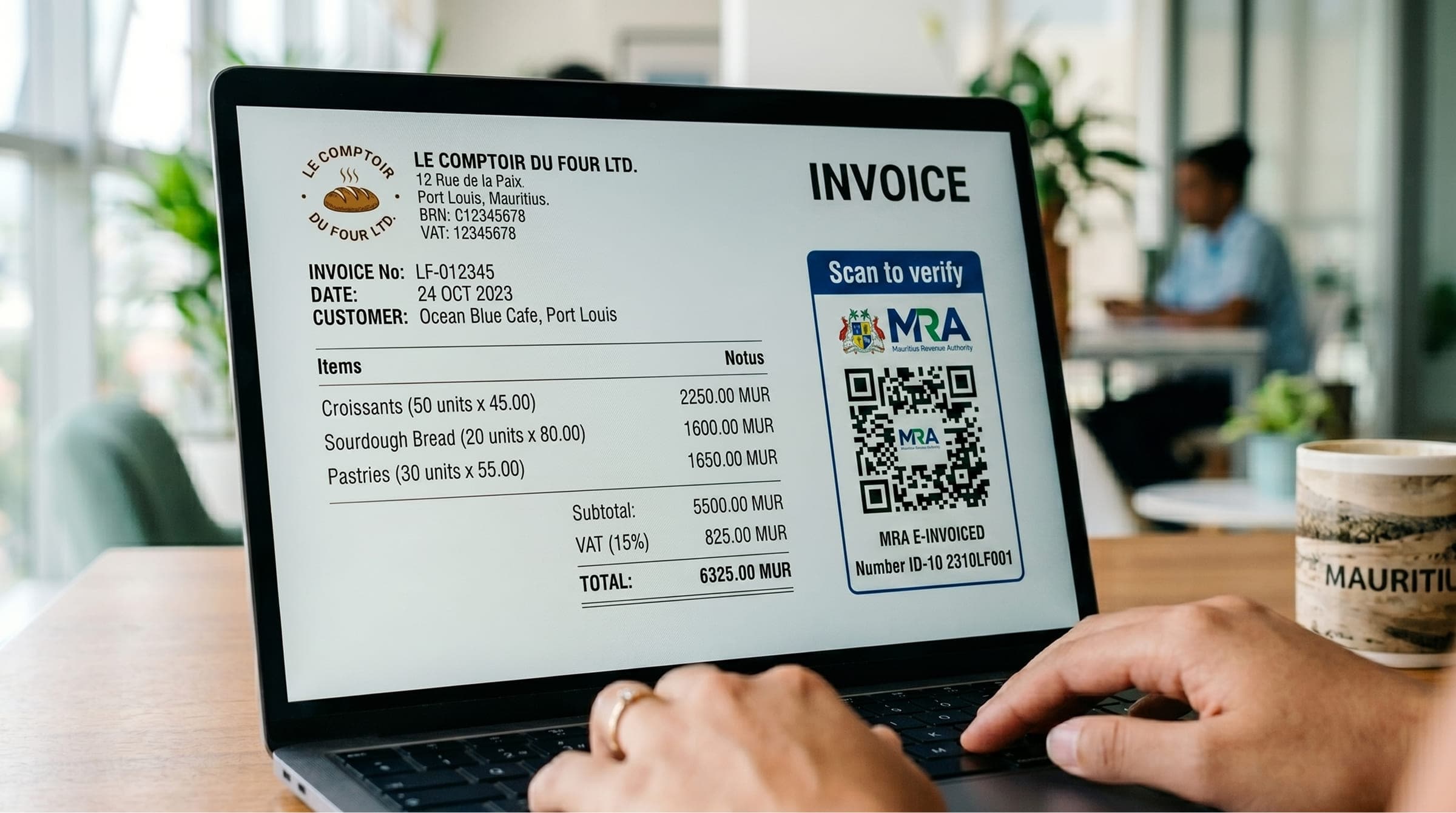
"E-invoicing", "real-time fiscalisation", "mandatory QR code"... Since 2024, these terms have been doing the rounds in entrepreneurs' WhatsApp groups and accounting firms across Mauritius and they cause anxiety. The Mauritius Revenue Authority (MRA) is indeed rolling out a national electronic invoicing system, in phases and the turnover threshold concerned keeps dropping year after year (MRA official e-Invoicing page).
For a Mauritian SME, the real question isn't "is this coming?" but "does it apply to me and when?". Here's what you actually need to understand, facts in hand and backed by official MRA sources, without the scaremongering.
What exactly is MRA e-invoicing?
E-invoicing (or fiscalised electronic invoicing) isn't just a PDF emailed to a customer. It's a system where each invoice is transmitted to the MRA in real time, before it's even handed to the customer. The MRA registers the transaction then sends you back proof that it has been declared.
The system rests on two building blocks (MRA e-Invoicing FAQs):
- The EBS (Electronic Billing System): your invoicing software, till, point of sale or ERP, as long as it's built to communicate with the MRA.
- The IFP (Invoice Fiscalisation Platform): the MRA's platform that receives, registers and "fiscalises" each invoice.
In practice, the flow is as follows: your EBS sends the invoice details (in structured JSON format) to the IFP; the IFP registers the transaction, generates an Invoice Registration Number (IRN) and a QR code, then sends them back to your software. You can then issue the fiscalised invoice to your customer.
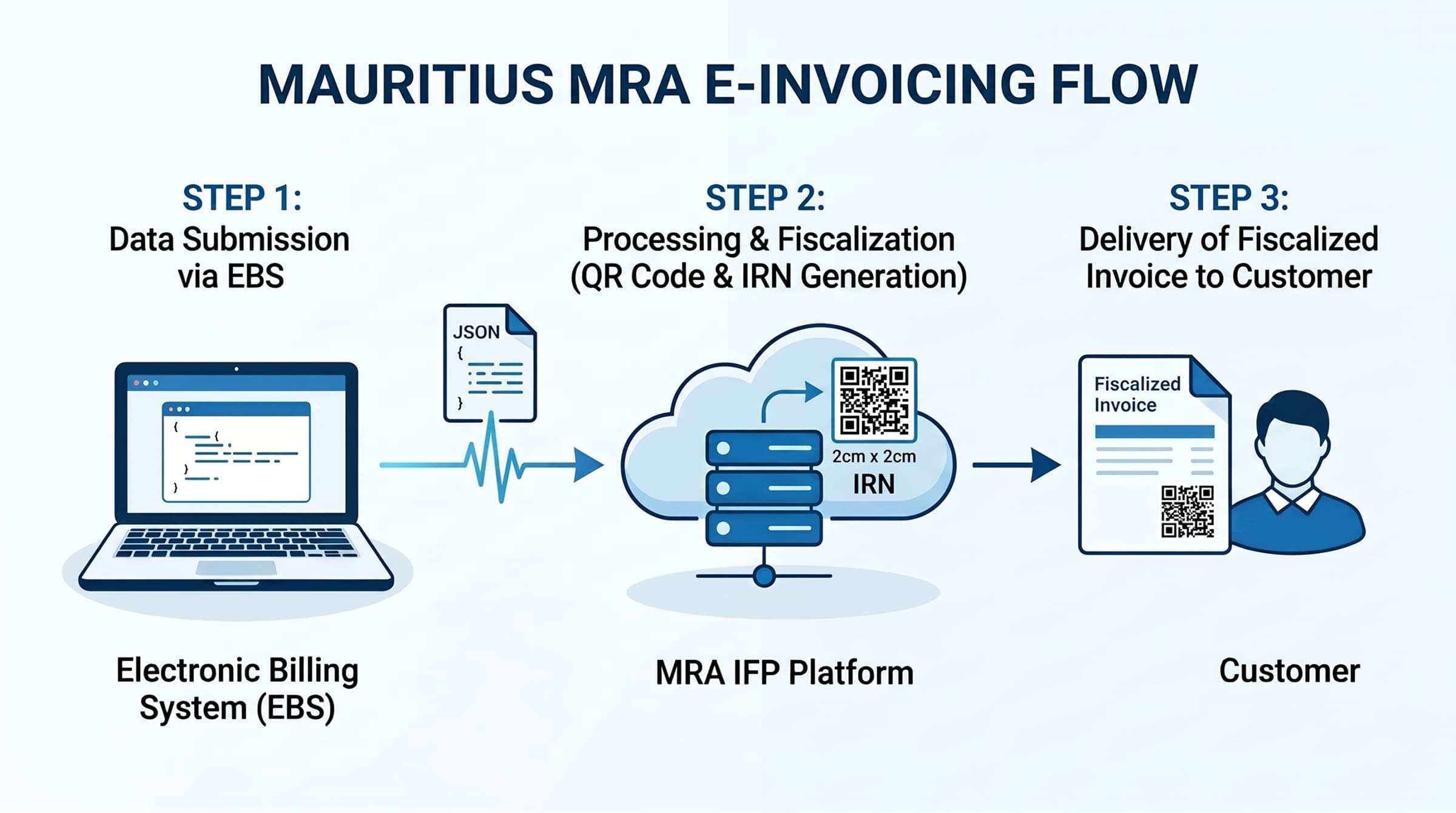
A small detail that causes confusion, even among some providers: the IRN must not appear on the invoice given to the customer. It's the QR code that must appear, at the mandated size of 2 cm x 2 cm (Standard e-Invoice Template, MRA). The legal framework rests on section 20A(2) of the VAT Act and the VAT (e-Invoicing) Regulations 2023, which came into force on 2 October 2023.
The rollout timeline (by turnover bands)
The MRA never imposed e-invoicing on everyone at once. The rollout happens in stages, starting with the largest businesses and gradually lowering the thresholds (MRA official timeline):
- Large taxpayers (LTD), turnover > Rs 100M: since 15 May 2024 (live);
- Medium/small taxpayers (MSTD), turnover > Rs 100M: 1 August 2025;
- Turnover > Rs 80M: 30 June 2026 (introduced via the 2025-2026 Budget);
- Turnover > Rs 40M: 1 September 2026.
The Rs 40 million threshold is, to date, the lowest band announced. The later phases, for businesses below that amount, have no official date yet. The trend is clear (the threshold keeps falling), but nothing is fixed yet for the smallest businesses.
Are you actually affected?
This is where many small businesses panic for nothing. Three points to keep in mind:
- E-invoicing isn't limited to VAT-registered businesses. The MRA's FAQ is explicit: the scheme also applies to persons who are not VAT-registered. So don't assume "I'm not VAT-registered, therefore I'm not affected".
- Below Rs 40M of turnover, you're not (yet) required to fiscalise your invoices, save for the special case below. No date has been published for this segment. Mind the wording: this isn't a permanent "exemption" but an obligation that simply hasn't reached you yet.
- The MRA's Director-General can notify you individually, in writing, to require e-invoicing and this "irrespective of your turnover level and whether you are registered for VAT or not" (section 20A(2)). As long as you've received no written notification and your turnover is below the threshold in force, a standard compliant invoice remains perfectly valid.
Don't confuse the VAT threshold (Rs 3M) with the e-invoicing threshold (Rs 40M)
This is the most common mistake and it costs a lot in needless stress. These are two separate obligations:
- VAT registration: compulsory from Rs 3 million of taxable supplies (the threshold dropped from Rs 6M to Rs 3M on 1 October 2025) or regardless of turnover for certain professions in the 10th Schedule to the VAT Act.
- E-invoicing (MRA fiscalisation): currently concerns turnovers above Rs 40M-100M depending on the band.
In other words, a business can be VAT-registered (turnover > Rs 3M) while remaining outside the scope of e-invoicing (turnover < Rs 40M). That's precisely the case for the vast majority of Mauritian SMEs. You must issue compliant VAT invoices but you have no obligation to fiscalise in real time via an EBS connected to the MRA.
Penalties for non-compliance
For businesses that are subject to e-invoicing, failing to issue fiscalised invoices costs Rs 10,000 per month (or part of a month) of failure, capped at Rs 200,000 in total (MRA e-Invoicing FAQ, Q18). A separate provision also penalises tampering with an EBS, up to Rs 50,000.
These penalties only apply to those who have genuinely entered the scope. If you're below the threshold and have received no notice, they don't target you.
How to prepare without panicking
Even if you're not affected today, the trajectory is unambiguous: the thresholds keep falling. Getting ahead is far cheaper than scrambling into compliance at the last minute. A few simple habits:
- Get your standard VAT invoices right now. Mandatory fields under section 20(2), sequential numbering with no gaps, the 15% rate, 5-year archiving. That's the baseline and it's what the MRA already checks today.
- Go digital. A business that already invoices properly through software will have a far smoother transition to an EBS than one still juggling Word and Excel.
- Watch your turnover against the bands (Rs 40M, then the thresholds to come) and stay alert to any written notification from the MRA.
- When the time comes, choose an EBS from the MRA's official list of certified providers (95 providers listed as at 15 June 2026).
FAQ
What is MRA e-invoicing?
It's a national electronic invoicing system where each invoice is transmitted to the MRA in real time, through an Electronic Billing System (EBS), before being handed to the customer. The fiscalisation platform (IFP) returns a registration number (IRN) and a 2 cm x 2 cm QR code that must appear on the invoice.
Is my business affected by e-invoicing in Mauritius?
The lowest band announced to date targets turnovers above Rs 40 million (from 1 September 2026). Below that, no date is set yet and you are not required to fiscalise your invoices, unless individually notified in writing by the MRA's Director-General, who can require it regardless of turnover.
Are e-invoicing and VAT registration the same thing?
No, they are two separate obligations. VAT registration is compulsory from Rs 3 million of taxable supplies (since 1 October 2025), whereas e-invoicing currently concerns turnovers above Rs 40M-100M. A business can therefore be VAT-registered without being subject to e-invoicing.
What are the penalties for e-invoicing non-compliance?
For businesses in scope, failing to issue fiscalised invoices costs Rs 10,000 per month (or part of a month) of failure, capped at Rs 200,000. Tampering with an EBS is penalised separately, up to Rs 50,000.
Not affected by e-invoicing yet? Get a head start anyway. VAT-Invoice.mu generates invoices compliant with section 20(2) of the VAT Act in seconds: mandatory wording, sequential numbering, 15% VAT calculation and secure 5-year archiving, accessible from your computer, tablet or phone. You stay compliant today and you approach the shift to e-invoicing with invoicing that's already clean and digital. Create your free account and issue your first compliant invoice today.