
Quotes
Quotes in Mauritius: how to write one, get it accepted and turn it into a compliant VAT invoice
· 11 min read
Share:


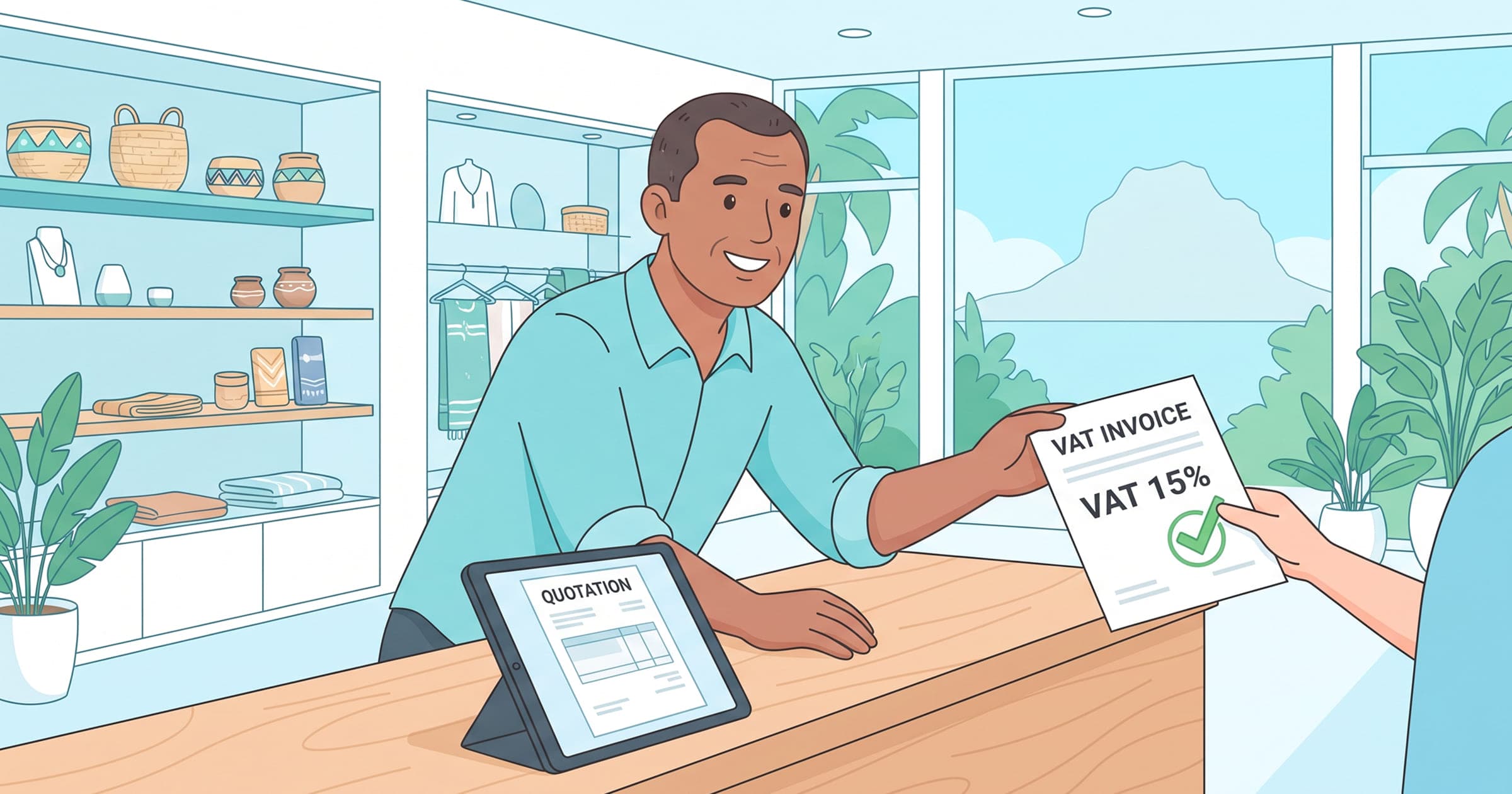
A quote is often written in ten minutes, between two appointments, in a Word file recycled from the previous client. Yet it's the document that commits your business the most. The invoice records an operation already carried out. The quote forms the contract the moment your client writes "bon pour accord" at the bottom of the page.
Since 1 October 2025, the compulsory VAT registration threshold has dropped from Rs 6 million to Rs 3 million of taxable turnover (MRA communiqué of 12 September 2025, Sixth Schedule to the VAT Act). Thousands of small Mauritian operators who until now sent quotes without ever mentioning tax must display 15% on their documents and then issue a genuine VAT invoice behind it. That's where the costly mistakes begin.
Here is what Mauritian law actually requires of a quote and what changes at the moment of conversion into an invoice.
What the MRA requires on a quote: nothing
Let's start with the news that surprises everyone. The VAT Act contains no provision on quotes, estimates or price proposals. The documentary obligation arises from the taxable supply, not from the commercial proposal: section 20(1) states that "every registered person who makes a taxable supply to any person shall issue to that person a VAT invoice in respect of that supply". The trigger is the supply. Not the document that precedes it.
The direct consequence: no wording is legally mandatory on a Mauritian quote and no format is prescribed. Everything you put on a quote is a matter of sound commercial practice.
That freedom looks like a comfort. It traps a lot of business owners all the same, because the real constraints don't come from the tax authority. They come from the Civil Code.
An accepted quote is a contract: in Mauritius it binds harder than elsewhere
The Mauritian Civil Code has kept the Napoleonic numbering. It never went through the French reform of 2016, which makes most of the articles quoted on French websites unusable here. The texts that matter are articles 1101, 1108 and above all 1134: lawfully formed agreements take the place of law for those who made them, they may be revoked only by mutual consent and they must be performed in good faith (Mauritian Civil Code, chap. C26).
An accepted quote therefore binds you to the price, the scope and the deadlines you wrote into it. Nothing indicative about it. And Mauritius goes further than France on this ground: the doctrine of imprévision has not been adopted, the courts refusing to revise a contract that has become too onerous for one of the parties (DLA Piper Africa / Juristconsult Chambers). If the price of cement climbs 20% after signature, the problem stays yours.
The Code even devotes an entire section to the subject, "Des devis et des marchés", at articles 1787 to 1799. Article 1793 lays down the harshest rule for the construction sector: an architect or contractor engaged to build a building for a lump sum according to an agreed plan cannot claim any price increase, neither for a rise in labour or materials, nor for changes made to the plan, unless those changes were authorised in writing with an agreed price. This rule targets lump-sum construction work, not every trade. It still gives you the right reflex to keep everywhere: every extra goes on a new accepted written document, never on a site conversation.
Two practical points. Article 1341 requires a written document above Rs 5,000 and bars proof by witnesses against the content of that writing: the "bon pour accord" signature doesn't so much create the agreement as prove it. That's exactly what you need the day the client disputes the amount. Acceptance itself must be pure and simple: a quote that comes back annotated, crossed out or hedged with reservations is not an acceptance, it's a counter-offer and you remain free.
As for the validity period, no Mauritian text sets one. You choose it. But once written on the quote, it binds you until it expires: you set the rule, your client can rely on it.
What a serious Mauritian quote contains
Since the law imposes nothing, what follows is professional practice. This is what your clients, their accountants and yours expect from a Mauritian quote:
- your full identity with your BRN and your VAT Registration Number if you are registered;
- the client's details, with their BRN if it's a business, which will save you time when the invoice comes;
- a line-by-line breakdown, with quantities and unit prices excluding tax, rather than an unreadable lump sum;
- the totals excluding VAT, the 15% VAT and the VAT-inclusive total, so that no amount is a surprise;
- the issue date and the validity date;
- the delivery time, the payment terms and the amount of any deposit;
- a number of your own, in a sequence distinct from the one used for your invoices;
- an acceptance block to be returned dated, signed and preceded by the handwritten words "bon pour accord".
A word on vocabulary, because the confusion is common here. A quote is a price proposal. A proforma invoice presents the characteristics of an invoice without proving a transaction and Mauritian regulation treats it as such. The two documents don't play the same role. In both cases, never title them "VAT INVOICE": that heading is reserved for the section 20 document.
Converting to a VAT invoice: the moment the law takes over
The quote has come back signed. From there, everything that was free becomes regulated. The invoice you issue must include, under section 20(2) of the VAT Act:
- the words "VAT INVOICE" in a prominent place;
- your name, business address, VAT Registration Number and BRN;
- its serial number and its date of issue;
- the quantity and description of the goods or the description of the services;
- the value of the supply, stating whether or not it is subject to VAT;
- where it is subject to VAT: the value of the supply, the amount of VAT chargeable and the rate applied;
- the exchange rate, where the value is expressed in a currency other than the rupee;
- if the buyer is VAT-registered: their name, business address, BRN and VAT Registration Number;
- if the buyer is a business that is not registered: their name, business address and BRN.
A detail many people miss: where a private individual asks for their name to appear on the invoice, section 20(2A) requires you to state their name, address and national identity card number. Every copy must also be kept legible, in chronological order, for at least five years after the transaction (sections 20(3) and 20(4)). The complete breakdown of these fields is covered in our guide on how to create a compliant VAT invoice in Mauritius.
Two questions come up systematically at this stage.
How long do I have to invoice after acceptance? No deadline in days appears in the VAT Act. But section 5(1) settles the question in its own way: if you collect payment before invoicing, the tax is already due for that period. The real deadline is therefore your collection.
Can the invoice reuse the quote's number? No. Section 20(2)(c) requires a serial number on the invoice, in a continuous sequence with no gaps. Your quote and your invoice live in two separate numbering sequences: the invoice issued from a quote takes the next number in your invoice sequence. It's the link between the two documents that ensures traceability, not a shared number.
The real problem happens between the two documents
Here is where the downloaded Word template shows its limits. The layout isn't the problem. The problem is that the quote and the invoice are two files that are strangers to each other.
You open the accepted quote, you copy the lines into another file, you change the title to "VAT INVOICE", you increment the number by hand, you recalculate the VAT. At every step, an opportunity to get it wrong: a forgotten line, a quantity changed at the last minute that doesn't follow through, a number already used last month, a missing client BRN. Multiply that by forty quotes a year. The gap between what the client signed and what you invoice them eventually happens. It always surfaces at payment time. The Excel or Word invoice template reproduces a layout; it guarantees none of these rules.
The clean chain is simple to describe: a dated quote with a clear validity, a status tracked through to acceptance, then an invoice generated from that quote, with the same lines, the same client and a new sequential number. Nothing to copy over, so nothing to break.
MRA e-invoicing: your quote is out of scope
One last point, because it worries a lot of business owners. The compulsory rollout of electronic invoicing happens in turnover bands, all of them launched to date (the MRA's e-invoicing page): above Rs 100 million for Large Taxpayers on 15 May 2024, above Rs 100 million for Medium and Small Taxpayers on 1 August 2025, above Rs 80 million on 30 June 2026 and above Rs 40 million since 1 September 2026.
The quote stays outside the perimeter. The mandatory "Document Types" field of the MRA's standard template admits only five values: STD for the standard invoice, PRF for the proforma, TRN for the training invoice, CRN for the credit note and DRN for the debit note. No code exists for a quote. The VAT (e-Invoicing) Regulations 2023 confirm this scope: the quote appears nowhere in them.
One reservation all the same, often left unsaid. Section 20A(2)(b) allows the Director-General to require by written notice that a business issue fiscal invoices, whatever its turnover and even if it is not VAT-registered. Not being caught by the bands doesn't mean being out of reach for good. For how the system works, see what businesses need to know about MRA e-invoicing.
FAQ
Is a quote mandatory in Mauritius?
No. No Mauritian text requires you to issue a quote before a job. It's a commercial choice and a protective one: an accepted quote fixes the price, the scope and the deadlines, then becomes enforceable against your client under article 1134 of the Mauritian Civil Code. Without a quote, it's your word against theirs.
How long does a quote stay valid in Mauritius?
No law sets a duration. You state it on the quote yourself and that date binds you until it expires. Thirty days is the most common practice for a service, to be shortened when your prices depend on imported materials. Without a validity date, your proposal can be held against you months later.
My client accepted the quote: can I still change the price?
Not unilaterally. An accepted quote is a contract and Mauritius has not adopted the doctrine of imprévision: a cost that explodes after signature doesn't entitle you to revise the price. You need an accepted amendment. For lump-sum construction of a building on an agreed plan, article 1793 of the Civil Code is stricter still: no increase is admissible unless the changes were authorised in writing with an agreed price.
Must a quote carry a sequential number like an invoice?
The law only requires it for the VAT invoice (section 20(2)(c)). Numbering your quotes in their own sequence remains strongly advisable: it avoids duplicates, lets you track your acceptance rate and makes reconciliation with the invoice issued afterwards easier. What is imperative is that the invoice itself skips no number.
Does a quote have to go through the MRA e-invoicing system?
No. The MRA's standard template recognises only five document types (STD, PRF, TRN, CRN, DRN) and none corresponds to a quote. Only invoices, debit and credit notes, training invoices and proformas fall within the system, for the businesses caught by the turnover bands.
A quote that becomes an invoice without being copied over is one error less per client. VAT-Invoice.mu generates your quotes with the same layout as your invoices: logo, VAT Number, BRN, line-by-line breakdown, totals excluding VAT, VAT and VAT-inclusive, validity date and a "bon pour accord" block. The status is tracked through to acceptance, then the VAT invoice compliant with section 20(2) is created in one click, with a new sequential number and a preserved link back to the original quote. Three quotes and three invoices a month are included in the free plan, with no credit card. Create your account and send your first quote today.